
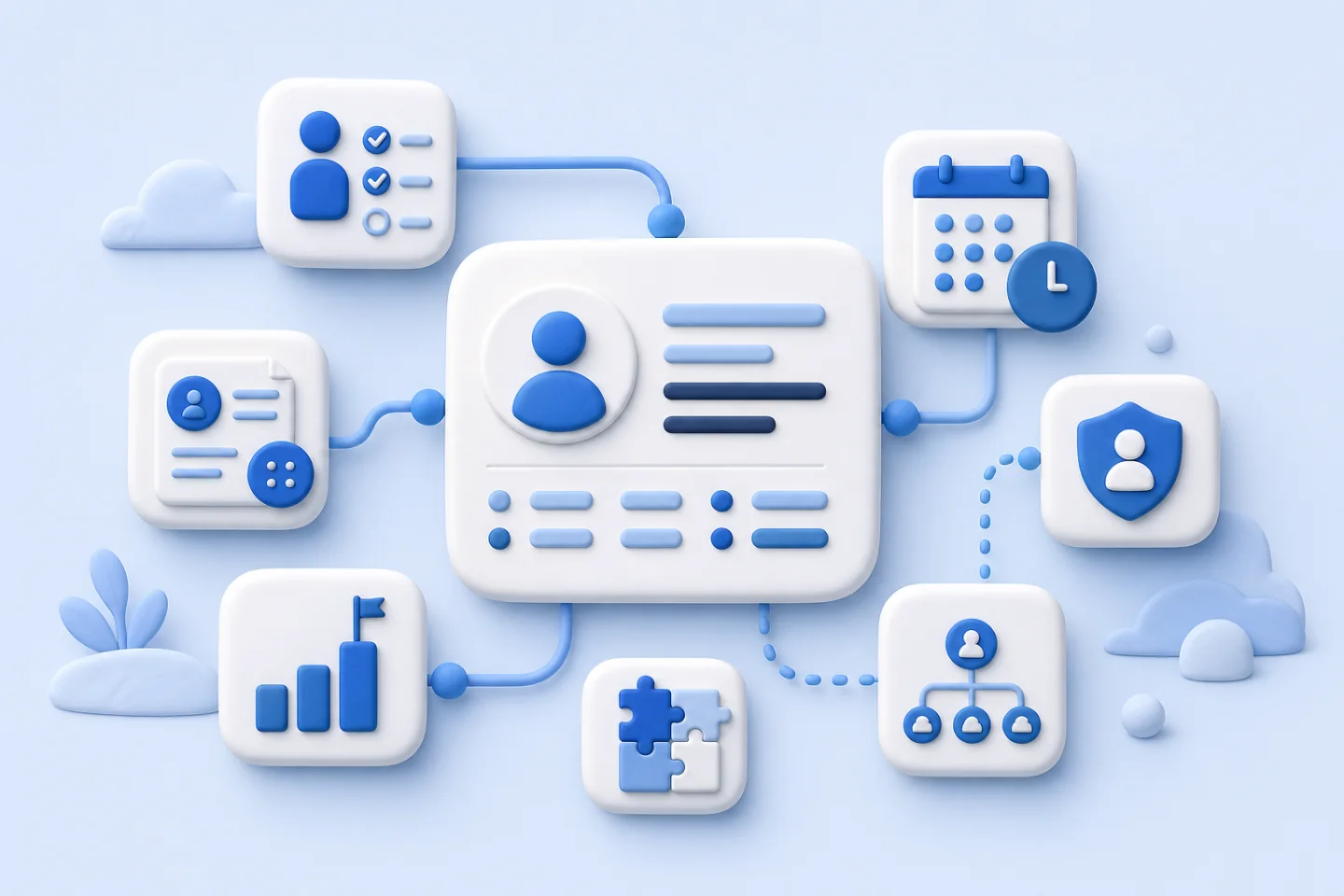
HR management software keeps employee records and recurring people processes in one controlled system. It can support recruitment, onboarding, time and leave, payroll inputs, performance reviews and reporting. The useful question is not which system has the longest feature list, but which one fits the organisation’s policies, workforce and existing technology.
Options range from focused tools to broad suites. Reviews of Cloud HR software can help teams learn the common categories, but a shortlist should start with documented requirements rather than rankings. A credible decision also accounts for implementation work, data protection, integrations and ongoing administration.
Define the problem before comparing systems
Begin with the processes that cause errors, delays or repeated data entry. Map how a new employee is approved, hired, added to payroll, given access and enrolled in benefits. Do the same for leave, job changes, performance reviews and departures. Record who owns each step, which information moves between teams and where exceptions occur.
Turn this map into requirements that can be tested. “Easy onboarding” is vague. “Assign forms by location, alert the hiring manager about incomplete tasks and export completion records” gives a supplier something specific to demonstrate. Separate requirements into essential, useful and unnecessary. This prevents an attractive secondary feature from outweighing a missing payroll or security control.
Include non-functional needs such as accessibility, response time, supported languages, data export and service availability. Note the number and types of users, including employees, line managers, HR administrators, payroll staff and temporary workers. Different roles need different views and permissions.
Prioritise the core capabilities
Employee records and self-service
A central record should hold employment status, job, manager, work location, effective dates and required documents. It should keep a history of important changes rather than overwrite them. Employees may need to update contact details or view policies, while access to pay, medical-related leave and performance information stays restricted.
Check whether administrators can define retention rules, correct errors without losing the audit trail and export records in a usable format. Role-based access should be precise enough to distinguish a direct manager from a payroll administrator or HR caseworker.
Time, leave and payroll inputs
Time and leave functions must reflect the organisation’s real rules. Test overtime, breaks, different work patterns, public holidays, carry-over limits and location-specific leave. Managers should see missing entries and exceptions before approved data reaches payroll. Employees should see balances and the status of requests without seeing private information about colleagues.
A unified approach to core HR, payroll, and compliance management can reduce duplicate entry, but software does not confirm legal compliance on its own. Payroll and HR specialists must validate calculations, approvals and reporting for every relevant jurisdiction.
Recruitment, onboarding and performance
Recruitment tools should preserve requisition approval, candidate status, interview feedback and hiring decisions in a controlled workflow. Onboarding should assign tasks by role and location, collect required forms and show incomplete actions. The system should flag exceptions instead of marking a process complete simply because its expected date has passed.
Performance functions should support goals, regular check-ins, evidence, review forms and development actions. Avoid systems that force every team into one rating scale when work differs substantially. Configuration cannot fix weak management practice: clear criteria, manager training and review of inconsistent decisions still matter.
Published lists of core HR software features and system requirements are useful prompts, not ready-made specifications. Remove features the organisation will not use and add its real approval, reporting and policy rules.
Match scope to organisational complexity
A small employer may need employee records, documents, leave, onboarding and a dependable payroll connection. A growing organisation may also need position control, recruitment workflows, compensation changes and consistent reporting across departments. A larger or multi-jurisdiction employer may need delegated administration, local policy rules, single sign-on and more detailed audit records.
Modular HR management systems can allow capabilities to be added as needs change. The benefit depends on whether modules share one reliable employee record and work together without duplicate configuration. Teams should ask what happens when they add a location, legal entity, pay group or language, and whether historic records remain understandable after organisational changes.
Do not assume growth requires every available module. Extra configuration increases testing, training and maintenance. Choose the smallest scope that solves the defined problems while leaving a clear path for likely changes.
Protect sensitive data
HR systems may contain identity documents, bank details, pay history, absence records and performance information. Security review is therefore part of selection, not a task for after purchase. Require multifactor authentication for privileged users, controlled administrator roles, encryption in transit and at rest, session controls and prompt removal of access when roles change.
Audit records should identify who viewed, exported or changed sensitive data, when the action occurred and which record was affected. Test whether logs cover permission changes, payroll details and bulk exports. Confirm how long logs and employee records are retained, how deletion requests are handled and where data and backups are stored.
Review every integration with the same care. A connection should receive only the fields it needs, use a protected authentication method and record failed transfers. The contract should explain incident notification, subcontractor controls, data return and secure deletion when the service ends.
Plan integrations and data ownership
List each system that exchanges employee information, such as payroll, finance, identity, scheduling and benefits administration. For every field, name one system of record. HR might own employment status and manager; payroll may own tax settings; finance may own cost centres. Without this decision, integrations can overwrite correct data with older values.
Document field mappings, effective dates and exception handling. A promotion approved for next month should not change access or pay immediately. Failed records should enter a visible queue with an owner and resolution process. Reconciliation reports should compare active status, manager, work location and other critical fields across systems.
Ask shortlisted suppliers to demonstrate integrations with realistic cases, including a future-dated transfer, a returning worker and a cancelled hire. A prepared slide or diagram cannot show whether errors are traceable or recoverable.
Evaluate cost, support and usability
Compare total cost over the intended contract period. Include subscription charges, implementation, configuration, data migration, integrations, training, support and internal staff time. Clarify which workers count for billing, which functions require extra modules, how renewals work and whether usable data exports carry a separate charge.
Use a scripted demonstration for every supplier. Give each the same scenarios and scoring scale. Ask an employee to update details, a manager to approve leave, an HR administrator to correct a record and a payroll user to investigate an exception. Record whether each task is clear, accessible and auditable.
Support matters most when a payroll, access or data problem is urgent. Ask about support hours, escalation routes, response targets and responsibility during implementation. Test available support channels during the evaluation, and distinguish documented commitments from planned features. Product roadmaps are context, not a substitute for capabilities available when the system is introduced.
Implement in controlled stages
- Clean the data. Identify duplicates, missing required fields, inconsistent job codes and obsolete records. Agree which source is authoritative before migration.
- Configure approved rules. Build workflows from written policies rather than informal workarounds. Record configuration decisions and owners.
- Test complete journeys. Cover hires, leave, pay changes, transfers, absences and departures, including rejected requests and failed integrations.
- Train by role. Employees need concise self-service guidance; managers need approval practice; administrators need correction, reporting and security training.
- Reconcile after launch. Compare migrated totals and records, monitor exceptions and keep a controlled route back for critical payroll or access processes.
Communication should state what is changing, when old processes stop and where users can get help. A phased launch may reduce risk when locations or processes differ, provided the team can prevent conflicting records between old and new systems.
Measure whether the system works
Success measures should reflect the problems defined at the start. Useful indicators include incomplete onboarding tasks, payroll corrections caused by HR data, time taken to approve leave, failed integrations, unresolved access requests and support cases by task. Login counts alone do not show that people can complete necessary work.
Review results by role, location or process where lawful and useful. A low completion rate may point to unclear instructions, poor permissions or an unsuitable workflow. Assign an owner to investigate and correct the cause. Schedule periodic checks of access, configuration, data quality and unused features so the system continues to match organisational needs.
The sound choice is the system that meets verified requirements, protects employee information and can be operated reliably by the people responsible for it. A disciplined evaluation makes that judgement visible before the organisation commits its data and processes.